Greetings everyone. Though I don't write here often, I figured now would be a good time to brush the dust away and start again, at least for a little while.
It's a weird time we are living in right now. As martial artists, we're unable to gather together to train, and most of our schools are closed thanks to Covid-19. For many martial artists, this is going to be a very trying time, as I don't believe many train alone, or at home. Without the formality of a dojang, and an instructor, it is understandable that motivation to train can drop. The overwhelming nature of not only having to figure out how to train, but also how to train yourself, in a space that may not support it can feel daunting.
As an instructor, self training is a bit of a double edged sword to me, and I find it hard to really parse. On one hand, "practice at home" has been a mantra repeated to me since I first started training way back in 1994. It was something I really took to heart and started doing when I was preparing for my black belt; and would eventually become a cornerstone into making me the martial artist I am today.
On the other hand, as an instructor who has a very deep understanding of the students I see weekly, there are definitely bad habits and flat out mistakes that I would not want to see strengthened by unsupervised repetition. Martial arts in the new school era take a much slower philosophical approach to correcting mistakes and eliminating bad habits. To suddenly not have a guide to give those subtle nudges in the right direction could lead to very hard to make corrections for students down the line. To that end, I'm going to write this with an underlying goal of preventing the pitfalls of self training.
Know Yourself
If you read my blog, you know I am a huge proponent of noce te ipsum. The best solo workouts come when you set out with a plan of what you want to get accomplished, and how you want to feel when you are done. This goes beyond answering that two part question with "a workout" and "good". If you are going to work from home, alone, you need to start thinking deeper than this.
Recently, my answer to these questions would be "memory retention of my forms" and "satisfaction", as my situation as a practitioner now relies mostly on being an effective instructor. For a student training for a test, I'd offer a much more nuanced suggestion of "Hitting every stance correct in X form" and "progress"
Once you have an idea of where you want to go, and how you want to feel when you get there, you can design your path. Let's look at some of the ways you can accomplish what you set out to do.
Basic Techniques
Though higher rank can find basic technique training boring and unnecessary, all you need is the mirror you look at every day before you walk out the door to go to work, combined with some patience to start a great workout. The best thing about basic technique training is that you don't need a lot of space to do it. Another great feature of solo basic technique training is that it can be as vigorous or as technical as you want.
Many of us can't wait to "get moving" when it comes to martial arts, but with limited space, moving can be difficult. Basic technique training is terrific because you don't have to move! Every technique can be practiced stationary, allowing you to work in the most constrained locations.
If you are looking at just "getting warmed up" pick a series of 5-10 techniques, execute them stationary in reps of 10-15 each. I'd recommend going in a punch, kick, block cycle, so my self training may see me start with punches in a straddle stance, switching to rising front kicks in a front stance, switching back to straddle for inward-outer forearm blocks. The beauty of this, is that if you are just looking to work off some energy, you don't even need a mirror per say. Just rattle the technique off with some intensity.
If you are looking to work on your technique execution, slow it down, get in front of the mirror, go online and get diagrams of the techniques you want to work on and take it in parts. Get in position, look at the diagram, look at the mirror and ask yourself "do I look like that"? Take it one step further and find someone who can execute the techniques near perfectly on youtube (this is going to be highly subjective, to your style of TKD, your organization, etc). After watching yourself in the mirror, and using diagrams, watch someone actually performing the technique at a high level and again ask "do I look like that"? Finally, if you can't figure it out, record yourself, and send it to someone like me, who could help you break down the mechanics of why it isn't happening for you.
Forms
Piggy-backing on the last part of the basic technique section, I would advise you to work with someone on forms and use technology. I'd be very cautious of doing forms over and over with no one watching. Although you can really work on memory retention this way, you can do more harm than good if you consistently do something wrong and strengthen that with 100s of reps. Leverage technology. Check in with a friend, or an instructor and get their feedback. It is not how we do things normally, but these are not normal times. Film yourself, watch the video, send the video for corrections.
As far as space goes, your front yard, back yard, local park, driveway - all can all be fine places to do your forms.
Pre-arranged
For those unfamiliar with the term, "pre-arranged" usually refers to one, two and three step training, as well as self defense. All of these can be practiced alone. Although having a partner is important for the timing and spacing aspect of these, you can strengthen your stances, power, and over all execution and all you need is some visualization to see in your minds eye the incoming technique you will be responding to.
Bag Work
I use two methods for solo bag work. If you have a standing bag, a bob, or a hanging bag, well...you are all set. I have none of these. So I use what I have on hand to get this training. I have a front yard full of dead trees (sadly). They make excellent heavy bags that I can use to good effect to work positioning, body control and mild power (I don't recommend blasting a dead tree with full force, it won't end well for you, and even if it does, in the long run you will hurt yourself more than the tree).
You can also find traditional training designs and blueprints online if you are handy. Makiwara boards, kicking boards, all of this can be found online and built with very low cost, if you are handy.
Putting It All Together
In a word - don't. I have found that one of the biggest secrets to self training successfully is to not try and have a regimented one hour karate class in your house run by yourself. I'm sure it can be done, but it is not something I would try to do for myself unless I was really feeling it. I'll usually pick one of these categories and work that in with treadmill work and weights. My biggest reason is burnout.
One to two categories per day will take you far, and allows you to maximize that category without succumbing to some of the more negative aspects of training alone. Again though, it all comes back to knowing yourself. If you are all about that training, then by all means, do it all every day. If you are struggling though, try one of these options and see how you feel after. I suspect it will be pretty good!
Wednesday, March 18, 2020

Wednesday, July 10, 2019
And Now for Something Completely Different.
I'd be lying if I said I only talk about the analytics of the martial arts. I have been told that I sprinkle my own opinion in to my posts enough to give them a proper amount of flavor, but tonight, I am going to talk about something a little different. There won't be a lot of analysis, no theory breakdown and no talk about technical accuracy or the science of the martial arts. Tonight, way too late to be starting a project like this, I'm going to just share some thoughts on taekwon-do.
Tonight my class was visited by a Grandmaster that I always enjoyed working with. He travels a lot, but training in my youth, I always looked up to him. Tonight, he watched me teach, and paid me all the praise an instructor could hope for. It was good, as it always is. Compliments from people like him, people with those last three bars that alone equal almost all of the time I have dedicated to the art telling you that they enjoyed my class is a tremendous honor and a hell of a compass calibration.
I can't help but feel a great deal of melancholy though. I was telling my wife a story about how he and I sparred one night, and how, it was a total mind game. I was a 2nd or 3rd dan, and still at the top of whatever fighting game I had (I was no slouch, but was never the best fighter in the school). He must have been 7th dan at the time. He could have bludgeoned me to victory. He didn't though, he took me right to the extreme limits of my fighting and kept me there, in a desperate back and forth, scoring points and getting scored on. He was never in any danger of losing, but I felt the entire time I was on the verge of winning. It was always a rare state to find a sparring partner like that - one that didn't exert their will on you, but held you at the brink of your limit, so that you could surpass yourself.
God I miss sparring like this. Maybe nostalgia and memory make these things into fishing stories; you know, the kind where a minnow caught turns into a shark? Still, anymore, my sparring matches are completely one sided one way or another. Either the person I am sparring is no match for me, or I'm simply out of shape and too injured to stand any kind of chance. It can be hard, but I keep my ego locked up pretty tight anymore. I mean, I've been there, and I've done that all before, right? Sure, I have...doesn't make the nights where you miss the old days any easier though. This grandmaster and I sparred twice that night, and I learned so much, moreso than 100s of other matches I had, with people of the same rank, lower, and even higher.
The match was a game of finesse, and of making the other person do what you wanted so you could score at will. Good free sparring is a game of dirty sleight of hand, and we were Penn and Teller that night. Feints, posturing, setups - no points scored on exploiting a slow hand, or with a blind sided attack; rather, every point was scored by causing an opening that simply couldn't close. It was magnificent.
Today's students are so different than I was when I was a 1st dan and up. I won't devolve this blog post into a "get off my lawn," rambling, but none of us had the potential that some of my current students do. They are so very talented, but because of that, their work ethic can be fleeting at times. I love teaching them, because my hope is that some day, they'll experience the glory, and the epic-ness like I have. That at least in their heads, if not on paper, or digitally they someday write of an amazing sparring match shared with a classmate or instructor.
Tournament glory is nice - and I've had my own small share of it. I can tell you though, even the best tournament matches I have fought don't compare to matches I've had in certain classes. The time Master Young cut me down with a spinning hook kick sweep and kicked me in the face before I fully hit the ground (when I was literally at the top of my fighting game); the endless matches with Master Pease, who frequently turned me into jello, or the time he spin hook kicked me in the face hard enough to blow the entire top off the "bottle cap challenge" and was shocked when I shook it off smiling; the time I made Master McCarthy nearly puke, or the time I impaled Oaks with my side kick; the time I tried to dive roll between Farrington and Barr, and they beat me to a pulp for it in a 2 on 1 match. Then there was the time Grandmaster DeStolfo told me what he was going to score on me with (a jumping backfist), hit me with it right in the face, laughed at me, and then told me he was going to do it again, and then did it again, and laughed some more - are memories I will cherish forever. I remember sparring with my man Jerry from NYC for hours and hours after classes, looking like a dalmatian from all the bruises on my arms. God, what a time to be a martial artist it was!
Now the price I pay for even throwing a kick above mid level too many times is 3 days of hip pain, some limping, and a lot of advil. I'm not, throwing a pity party though, it was worth it all - and if I had to do it again, I would, because at the end of the day, those sparring memories are some of the best times of my life.
So work hard, enjoy the art, and live for the moment. If you have potential, stop effing around and unlock it. Listen to the old heads, because they walked a different road and can tell you so much.
Tonight my class was visited by a Grandmaster that I always enjoyed working with. He travels a lot, but training in my youth, I always looked up to him. Tonight, he watched me teach, and paid me all the praise an instructor could hope for. It was good, as it always is. Compliments from people like him, people with those last three bars that alone equal almost all of the time I have dedicated to the art telling you that they enjoyed my class is a tremendous honor and a hell of a compass calibration.
I can't help but feel a great deal of melancholy though. I was telling my wife a story about how he and I sparred one night, and how, it was a total mind game. I was a 2nd or 3rd dan, and still at the top of whatever fighting game I had (I was no slouch, but was never the best fighter in the school). He must have been 7th dan at the time. He could have bludgeoned me to victory. He didn't though, he took me right to the extreme limits of my fighting and kept me there, in a desperate back and forth, scoring points and getting scored on. He was never in any danger of losing, but I felt the entire time I was on the verge of winning. It was always a rare state to find a sparring partner like that - one that didn't exert their will on you, but held you at the brink of your limit, so that you could surpass yourself.
God I miss sparring like this. Maybe nostalgia and memory make these things into fishing stories; you know, the kind where a minnow caught turns into a shark? Still, anymore, my sparring matches are completely one sided one way or another. Either the person I am sparring is no match for me, or I'm simply out of shape and too injured to stand any kind of chance. It can be hard, but I keep my ego locked up pretty tight anymore. I mean, I've been there, and I've done that all before, right? Sure, I have...doesn't make the nights where you miss the old days any easier though. This grandmaster and I sparred twice that night, and I learned so much, moreso than 100s of other matches I had, with people of the same rank, lower, and even higher.
The match was a game of finesse, and of making the other person do what you wanted so you could score at will. Good free sparring is a game of dirty sleight of hand, and we were Penn and Teller that night. Feints, posturing, setups - no points scored on exploiting a slow hand, or with a blind sided attack; rather, every point was scored by causing an opening that simply couldn't close. It was magnificent.
Today's students are so different than I was when I was a 1st dan and up. I won't devolve this blog post into a "get off my lawn," rambling, but none of us had the potential that some of my current students do. They are so very talented, but because of that, their work ethic can be fleeting at times. I love teaching them, because my hope is that some day, they'll experience the glory, and the epic-ness like I have. That at least in their heads, if not on paper, or digitally they someday write of an amazing sparring match shared with a classmate or instructor.
Tournament glory is nice - and I've had my own small share of it. I can tell you though, even the best tournament matches I have fought don't compare to matches I've had in certain classes. The time Master Young cut me down with a spinning hook kick sweep and kicked me in the face before I fully hit the ground (when I was literally at the top of my fighting game); the endless matches with Master Pease, who frequently turned me into jello, or the time he spin hook kicked me in the face hard enough to blow the entire top off the "bottle cap challenge" and was shocked when I shook it off smiling; the time I made Master McCarthy nearly puke, or the time I impaled Oaks with my side kick; the time I tried to dive roll between Farrington and Barr, and they beat me to a pulp for it in a 2 on 1 match. Then there was the time Grandmaster DeStolfo told me what he was going to score on me with (a jumping backfist), hit me with it right in the face, laughed at me, and then told me he was going to do it again, and then did it again, and laughed some more - are memories I will cherish forever. I remember sparring with my man Jerry from NYC for hours and hours after classes, looking like a dalmatian from all the bruises on my arms. God, what a time to be a martial artist it was!
Now the price I pay for even throwing a kick above mid level too many times is 3 days of hip pain, some limping, and a lot of advil. I'm not, throwing a pity party though, it was worth it all - and if I had to do it again, I would, because at the end of the day, those sparring memories are some of the best times of my life.
So work hard, enjoy the art, and live for the moment. If you have potential, stop effing around and unlock it. Listen to the old heads, because they walked a different road and can tell you so much.
Wednesday, May 15, 2019
Of Memes and Messages
If you are a martial artist, and you follow or have a following of martial artists in your social network, you no doubt have seen countless memes about the art and have read a plethora of different martial arts motivation posts.
The sheer amount of toxicity that gets passed around as "a good post" in some of my network's mind has me absolutely staggered. Although initial drafts of this post were written in a much more terse voice, I have scaled it back the best I can, because I remember a time when I didn't see the forest for the trees like I do now. I took a class in college a long time ago, that really explored the messaging in pop culture and how it speaks to us. It was an eye opening class, one that allowed me to see a lot of subtle messages in the media we consume that sometimes we don't even realize we're receiving.
What I'd like people to take away from this post, especially school owners, is that your students are very likely going to hang (sometimes unhealthily) on everything you say and post. My hope is that by pointing out some of the toxic messaging in this, I can get you thinking a little bit more about what you post.
Let's take this example, a favorite among black belt instructors and school owners as a start:
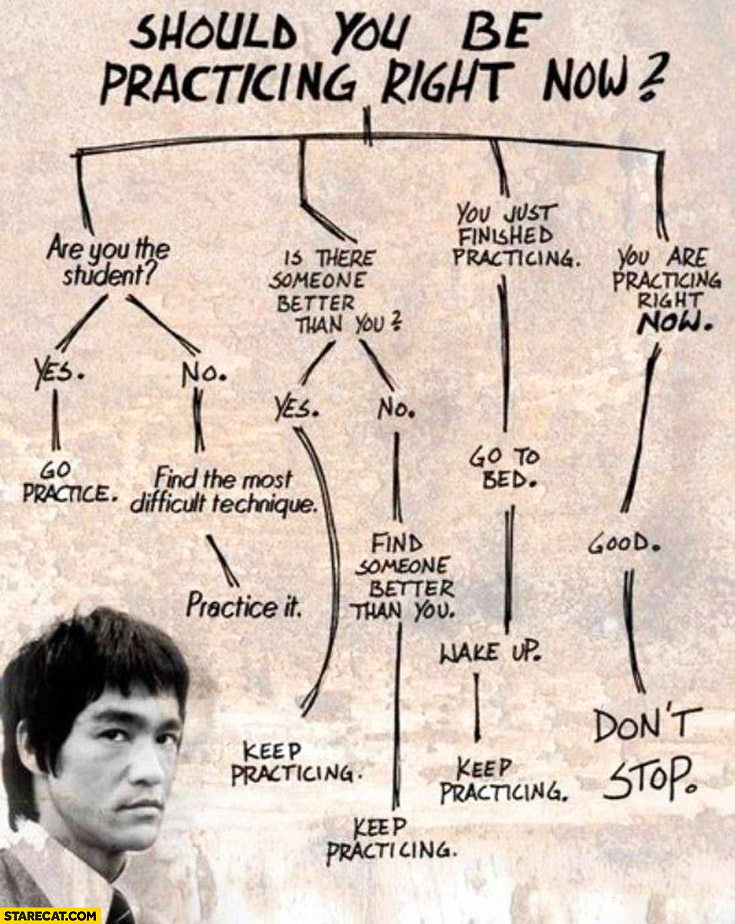
First off, we attach a picture of the patron saint of all martial arts, the one and only Bruce Lee. So of course, as martial artists, it must not only be true, but it must be some nugget of wisdom that came from the legend himself right? No, google "should you be practicing" and you'll find the image of Bruce replaced with any number of other objects and graphics. That's only one small problem with this piece, another is the messaging itself.
First off, as a working adult, with two kids and a wife that expect me to spend time with them, I can't follow this picture. Yet, I can't help but feel just a tiny bit of inadequacy when I see peers or worse, instructors post this. It makes me want to reach out to any instructor and ask them if this is what they really expect from their students. Having the expectation that your students practice every waking hour of their life is not healthy. It's not healthy to consider, and it is even more unhealthy to push on your students. I'm glad as a teenager I didn't train in the social media era, because if my instructor had posted this, I might have quit all of my other activities and my job and tried this. Hyperbole? Maybe, but I hung on everything my instructors said - and had they said something like this, you better believe I would have tried. There is nothing like unsupervised practice to bring out the absolute hardest to break bad habits for most people though - is this really what you want to deal with?
Looking specifically at this picture, the first branch starts a major problem with the message here. "Are you the student - yes or no". Well, according to a lot of the other propaganda I see passed in the martial arts, I thought we were all life long students - so how can you even have a no answer?! This is a paradox isn't it? Let's ignore that glaring detail, and look at what happens when we say no which leads to the real problem with this piece.
"Find the most difficult technique - practice it". How does this not infuriate you and immediately show you the invalidity of this piece if you know anything about instruction? You don't get better by practicing the "most difficult technique" at anything. You accomplish the most difficult technique of anything by being really, really good at what makes up that difficult thing - the basics. If you don't understand the problem with suggesting that someone practice the most difficult technique as a proper course of action, you should maybe not be teaching. Do you teach Moon-Moo to white belts? No, you teach them Chon-ji, but by this picture's logic, we should be teaching white belts the most difficult form in the entire 24 form set. I have seen with my own two eyes people who can do complex aerial techniques but couldn't front kick out of a wet paper bag. It's toxic messaging at this point.
Let's look at another aspect of this that is totally wrong - and sends a contradictory message at best and a hypocritical message at worst to your audience. "Is there someone better than you?".
You, school owner or instructor or person of influence who posted, or is thinking of posting this meme; is that what the martial arts are you to? A way to be better than someone else? What happened to all the other memes about the only person we are competing with is ourselves? What happened to humility? You didn't think about that? You didn't think...but you consider yourself a person of high quality or influence...hmmm.
Look, I get it, I'm not trying to be the fun police, and I get the lighter gist of this is that we could all practice more. I'm telling you all, that there are better ways to get that message out there. For instance, instead of a post like this, how about you take a picture of yourself practicing at some strange hour, or while on vacation, and making your own meme? I have told my students on numerous occasions that when I was a serious competitor, I would watch TV, but get up and hold a stance for the entire run of a commercial break.
Here's another pair I can't stand:

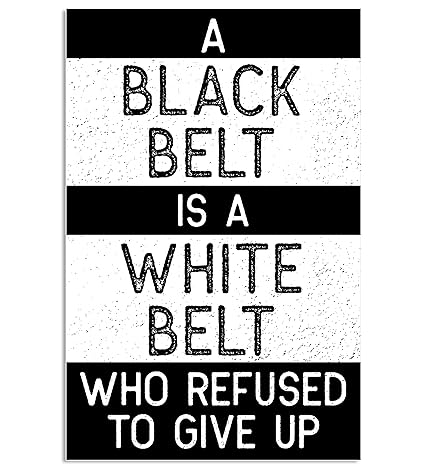
Ok, these messages are true, but only by default. Of course the master has failed more than the beginner has tried, he's been doing it for years. Same with a black belt who "never gave up". Is this what you want your experienced students to see - that you are equating their only difference to a beginner being the number of times they have failed or the lack of "quit"?
You want to know the real difference between a beginner and a master? How about X number of years of dedication to the arts? What about precision, and technique mastery, of hours sweating, and missed family events for testings, tournaments, seminars? How about years of self study, of networking and self motivation to be the best martial artist you can be because you surpassed the title of beginner about 6 months into your training? Did we suddenly forget all of them in an attempt to create a saccharine message for potential new students?
There are no similarities between a beginner and a master, and there is a heck of a lot more to a proper black belt than just a no quit attitude. Do you really want your new students to read this and think "all I have to do is survive in class a long time and I'll be gifted a black belt"? Because, when I read this, that's what I see. If you are going to bemoan the "participation award generation" for being too soft, perhaps make sure you haven't posted messaging to advance that mentality no?
Here is by far the worst example of this meme:

With respect, to GM JR West, this is just a completely illogical statement spawned from the pools of over-romanticized nonsense. Let's spin this another way - if your doctor walked in to your hospital room on the day of a surgery and said to you that he still considered himself a beginner - would that fill you with confidence? If my hip doctor had said "Well DK, I have done over a thousand of these surgeries, but I still consider myself a beginner at it" I would have walked out. Beginners are supposed to make mistakes, and that is ok. If you aren't holding your black belts and masters to a higher quality level than a beginner, you are doing it wrong!
Again, I get it, martial artists like to believe they are humble and like to teach the message that there is always something to learn. Here's the problem - if you don't just inherently know that there is always going to be more things to learn by the time you get to black belt, then you haven't been paying proper attention. If you have to remind your student body of this over and over with memes on social media, you are not teaching properly. Also, and again, way to belittle your advanced rank. Why even differentiate with rank if this is the way you feel - just go back to the myth that there never were any colored belts and that a black belt was just a white belt that got dirtier and dirtier over time practiced.
I'm not a person to not offer better alternatives, here's a few I do like that get the same messages across in a better way:

This sums up being a black belt kind of perfectly. This speaks so much more to what makes a good foundation for an excellent black belt and eventual master - way more so than the previous examples. It does this without minimizing the work or the accomplishments of your existing body.
Here's another one, aimed at beginners that I love - because it really makes a great solid point, again, without looking at established ranks:

A simple message, that gets the point across. Hell, I'd rather be a bad black belt than a dude sitting on the couch. So this message even motivates me, a sixth degree black belt!
These two messages are some of the examples of a messaging type that gets the proper points across. You're not preaching a lifestyle of unchecked physical conditioning, or bringing down your existing group of students in the hopes of attracting new students by minimizing the amount of work that goes into martial arts accolades - you are using actual positive motivation.
Memes and messages are powerful, and as school owners, instructors or even people of influence, we need to be aware of what we are really saying when we post things.
First off, as a working adult, with two kids and a wife that expect me to spend time with them, I can't follow this picture. Yet, I can't help but feel just a tiny bit of inadequacy when I see peers or worse, instructors post this. It makes me want to reach out to any instructor and ask them if this is what they really expect from their students. Having the expectation that your students practice every waking hour of their life is not healthy. It's not healthy to consider, and it is even more unhealthy to push on your students. I'm glad as a teenager I didn't train in the social media era, because if my instructor had posted this, I might have quit all of my other activities and my job and tried this. Hyperbole? Maybe, but I hung on everything my instructors said - and had they said something like this, you better believe I would have tried. There is nothing like unsupervised practice to bring out the absolute hardest to break bad habits for most people though - is this really what you want to deal with?
Looking specifically at this picture, the first branch starts a major problem with the message here. "Are you the student - yes or no". Well, according to a lot of the other propaganda I see passed in the martial arts, I thought we were all life long students - so how can you even have a no answer?! This is a paradox isn't it? Let's ignore that glaring detail, and look at what happens when we say no which leads to the real problem with this piece.
"Find the most difficult technique - practice it". How does this not infuriate you and immediately show you the invalidity of this piece if you know anything about instruction? You don't get better by practicing the "most difficult technique" at anything. You accomplish the most difficult technique of anything by being really, really good at what makes up that difficult thing - the basics. If you don't understand the problem with suggesting that someone practice the most difficult technique as a proper course of action, you should maybe not be teaching. Do you teach Moon-Moo to white belts? No, you teach them Chon-ji, but by this picture's logic, we should be teaching white belts the most difficult form in the entire 24 form set. I have seen with my own two eyes people who can do complex aerial techniques but couldn't front kick out of a wet paper bag. It's toxic messaging at this point.
Let's look at another aspect of this that is totally wrong - and sends a contradictory message at best and a hypocritical message at worst to your audience. "Is there someone better than you?".
You, school owner or instructor or person of influence who posted, or is thinking of posting this meme; is that what the martial arts are you to? A way to be better than someone else? What happened to all the other memes about the only person we are competing with is ourselves? What happened to humility? You didn't think about that? You didn't think...but you consider yourself a person of high quality or influence...hmmm.
Look, I get it, I'm not trying to be the fun police, and I get the lighter gist of this is that we could all practice more. I'm telling you all, that there are better ways to get that message out there. For instance, instead of a post like this, how about you take a picture of yourself practicing at some strange hour, or while on vacation, and making your own meme? I have told my students on numerous occasions that when I was a serious competitor, I would watch TV, but get up and hold a stance for the entire run of a commercial break.
Here's another pair I can't stand:
Ok, these messages are true, but only by default. Of course the master has failed more than the beginner has tried, he's been doing it for years. Same with a black belt who "never gave up". Is this what you want your experienced students to see - that you are equating their only difference to a beginner being the number of times they have failed or the lack of "quit"?
You want to know the real difference between a beginner and a master? How about X number of years of dedication to the arts? What about precision, and technique mastery, of hours sweating, and missed family events for testings, tournaments, seminars? How about years of self study, of networking and self motivation to be the best martial artist you can be because you surpassed the title of beginner about 6 months into your training? Did we suddenly forget all of them in an attempt to create a saccharine message for potential new students?
There are no similarities between a beginner and a master, and there is a heck of a lot more to a proper black belt than just a no quit attitude. Do you really want your new students to read this and think "all I have to do is survive in class a long time and I'll be gifted a black belt"? Because, when I read this, that's what I see. If you are going to bemoan the "participation award generation" for being too soft, perhaps make sure you haven't posted messaging to advance that mentality no?
Here is by far the worst example of this meme:
With respect, to GM JR West, this is just a completely illogical statement spawned from the pools of over-romanticized nonsense. Let's spin this another way - if your doctor walked in to your hospital room on the day of a surgery and said to you that he still considered himself a beginner - would that fill you with confidence? If my hip doctor had said "Well DK, I have done over a thousand of these surgeries, but I still consider myself a beginner at it" I would have walked out. Beginners are supposed to make mistakes, and that is ok. If you aren't holding your black belts and masters to a higher quality level than a beginner, you are doing it wrong!
Again, I get it, martial artists like to believe they are humble and like to teach the message that there is always something to learn. Here's the problem - if you don't just inherently know that there is always going to be more things to learn by the time you get to black belt, then you haven't been paying proper attention. If you have to remind your student body of this over and over with memes on social media, you are not teaching properly. Also, and again, way to belittle your advanced rank. Why even differentiate with rank if this is the way you feel - just go back to the myth that there never were any colored belts and that a black belt was just a white belt that got dirtier and dirtier over time practiced.
I'm not a person to not offer better alternatives, here's a few I do like that get the same messages across in a better way:
This sums up being a black belt kind of perfectly. This speaks so much more to what makes a good foundation for an excellent black belt and eventual master - way more so than the previous examples. It does this without minimizing the work or the accomplishments of your existing body.
Here's another one, aimed at beginners that I love - because it really makes a great solid point, again, without looking at established ranks:
A simple message, that gets the point across. Hell, I'd rather be a bad black belt than a dude sitting on the couch. So this message even motivates me, a sixth degree black belt!
These two messages are some of the examples of a messaging type that gets the proper points across. You're not preaching a lifestyle of unchecked physical conditioning, or bringing down your existing group of students in the hopes of attracting new students by minimizing the amount of work that goes into martial arts accolades - you are using actual positive motivation.
Memes and messages are powerful, and as school owners, instructors or even people of influence, we need to be aware of what we are really saying when we post things.
Sunday, January 6, 2019
Koenig's Anatomy of a Form (Part 1) Overview
Introduction
After a while, mostly spent moving things around in Visio, listening grudgingly to my wife (a 3rd dan, who I have come to trust on many matters); I decided "this isn't that big of a deal". It was at that point I was content to let this project die on the PCs I copied said Visio files to. They'd be deleted in a few more months when I realized how silly I was for thinking that I could do anything actually insightful.
Finally, I decided that I am just going to put this out there, and maybe teach forms with this as an underlying method. My hope is that at least one person who sees it says "wow, this is great - I never thought of forms like this" or even better, if they can use this to help teach forms themselves. I think that it will help people take a look at an aspect that a student (or themselves) is struggling with, and help them find exactly what they need to do to improve that aspect.
The basic idea of my anatomy of a form came from two places. First, as I get older, and I'm not able to train the way I'd like to, I wanted to prove to myself that I could really contribute to the art without being a person who trains religiously. There is a heavy stigma though, placed on the instructor who doesn't train like they did in their youth. I think this is unwarranted, and believe that as long as you are involved in the art in some way, you are connected to the art and can have valuable insights. I feel like only martial artists seem to think that you can only have something critical to say if you are training like a 20 year old.
It also came about because I was thinking about what makes a form a good form. I started to think about all the moving parts of a form, and realized that it is really difficult to articulate all that goes on in a given form. That led me to realize I had never even seen an all encompassing description of it written. I started to write about it months ago, and realized that writing alone wasn't going to do it justice. So this post is my attempt to illustrate all that goes on in a form. Let me say that Visio is not the perfect media for this. Forms are not flat; they are not 2 dimensional. Many of the sections of these illustration that you see are happening at the same time as other parts and some are happening because of other parts. It's hard to put something so dynamic down on on paper. Forms, good forms are like a complex factory machine, there are a lot of moving parts, many you would never see by looking at it from the outside. You have to know the moving parts are there. These illustrations I hope are a way to highlight the things you may not be seeing.
Here's a quick reference for what you are going to see. Try not to get too hung up on the lines and the shapes. Again, a 2 dimensional medium is not the best way to describe a dynamic 3 dimensional movement, but sometimes, it is what we have.
Lines:
- Red Lines - These are the extensions of mental mastery. These are places where your mind is doing more of the action than the physical side of your body.
- Green Lines - These are what I call facilitation lines. I use the green lines when something directly facilitates another aspect.
- Blue Lines - These are what I call "lead to" lines. They differ from green lines in that you can theoretically have one side without the other.
Shapes:
- Circles - These are intangible attributes.
- Squares - These are the tangible physical attributes of the form.
- Ovals - Ovals are the "in between" They are attributes that bridge the intangible and the tangible.
Section 1 - The Mental

My graphic starts with the top most attribute being "Mental Mastery". Mental mastery is a very slippery concept because it encompasses so many things. All movement starts with a thought to move. So all martial arts start with a mental idea to do so. Our breathing, which facilitates our life and all vigorous movement, is controlled by the mind (consciously in some cases, subconsciously in others). At our most basic levels of movement our mind is our engine. Although breathing is going to play a bigger role in the movement section, I am including it in this breakdown because it is a physical attribute that is directly controlled by the mind.
Moving beyond the basic motor functions, our mind is where memorization occurs, and this happens in several capacities. First we have to memorize what the techniques are - this is what I call this technique positioning. For example, knowing that a certain punch in a form is meant to be high section, but also, knowing what "high section" means and where a technique that is "high section" goes. Next we have application of the technique. In forms, application of the technique is what sells the effectiveness of the technique. In order to do a good form, the movements have to look like they would work. You can have the correct technical positioning, but also, be clueless on its application. Many times someone who has this shortcoming will look dispassionate; their movements, robotic or static.
Application of technique and technique positioning feed into each other. As someone's positioning increases, their understanding of the application can grow, and vice versa. This won't hold true on every technique - some things need to be shown first, but as you flow from the right side of the mental to the left, you notice that the whole thing repeats. Each step, in a clockwise cycle increases the effectiveness of the next and it never stops.
Where "technique positioning" is the static, stopped position of the technique, the bottom 4 technique blocks (from a mental standpoint) would be considered the techniques in motion. In a good form, the end of a movement is usually a stop, and your accuracy of your technique is often judged here. There is more to a technique than just the beginning point and the end point. The bottom 4 blocks are the techniques in motion.
Surely you have had a student, or saw a student who can throw a beautiful round house kick, but their bottom foot never pivots enough to really release the power of that technique. This is what the bottom 4 blocks represent in the mental side. I believe the movement of the technique and the end point of the technique are unique aspects of having a good form so I have separated them. Simply stated, in terms of moving in that clockwise cycle, once you have a beginning and an end point, you can begin to refine the in between.
As this cycle repeats over and over again, more mental mastery attributes are gained. Confidence increases, mental discipline increases, fear is abated, and understanding of the art is gained. I would like to list everything, but I'd have no room in the diagrams to post anything else! Suffice to say, the mental aspects of form training are extensive and many are often overlooked.
Section 2 - Movement

We already established that all movement starts with a thought and that breathing is what powers our body. If we do not breathe, we're not going to be able to move for very long before we pass out. Afterall, no instructor has ever been heard saying "now hold your breath" to a student doing anything. Quite the contrary, "breathe" is advice given for so many things. Students who are struggling with stamina, students that are nervous, angry, or upset - a typical first piece of advice is always to "just breathe". We take it for granted I think, but breathing is one of the most fundamentally important things we do in life in general, let alone in martial arts training. Breathing allows us to make the small and large movements we perform in the martial arts.
Small movements are the subtle things we do. These are weight shifts, hip turns, head and eye movements. I would classify them as the micro elements that make up actual movement. These happen before an actual technique is even initiated (like a look, or a head turn) or, like hip rotation or a weight shift, happen during the actual technique. These subtle movements, or the lack of them, can have huge ramifications for a form. Without a focus on small movements, forms will rarely leave a mediocre state.
Large movements are the movements that aren't part of the actual technique. I am thinking primarily of stepping, turning and chambering. Though you can argue that chambering is part of the actual technique execution, I would disagree. Chambers can vary depending on the technique and the intent of use of the technique. With very few exceptions turns and stances are not tied to any particular technique, and chambers are the same way. We see this primarily with how fighting differs from forms. In fighting, we try to disguise our kicks by throwing them all with the chamber of a front kick. Though we would never do this in forms (unless, it was called for), that versatility makes chambering belong, in my opinion here in the movement section, and not a part of any defined technique. If you do not properly chamber your technique, you cannot properly execute it. So a successful technique depends on this long movement. The same is true of turns and stances. These large movements are the foundations of the techniques, if the foundation is bad, the technique is bad.
Negative movements are the stops after each technique in the form. This is such an important part to doing a good form. Negative movements keep the proper pace in the form. Without it, you have movements bleeding into each other, which looks sloppy, or too much pause which makes the form look robotic. The proper negative movements should be a learned execution just as any movement is because they can vary, from technique to technique and from form to form.
Furthermore, negative movement isn't just movement to movement - it's also about the start and stop of the whole technique. Having the proper stop time means your punches, blocks or kicks don't waggle to a stop, but have stillness factor. This comes only from refining your movements over years of practice and accomplishing balance in all aspects of your form.
The culmination of small movements, and large movements with the correct stop time in between is body control. Body control is the figurative balance point where the physical movement and the mental understanding of how to move meet. Combined with technique positioning from the last section, we end up with a strong foundation for technique execution. A person with body control knows where everything goes, and gets it there the correct way.
Section 3 - Technique

On the heels of movement comes the technique portion, and "on the heels" couldn't be more apt. Think about a single technique, executed from a ready stance, or if in the middle of a form, the stop of the last technique. You breath in, look in the correct direction, see the target of the technique, set your hips and your weight the right way, chamber - all of the movement section items happen and happening - then: technique! Your movement items drive the technique.
You'll notice there are a lot more items on this segment of the chart and this is because the technique would be the macro level of everything going on in the form. Technique is the easiest part to see and the place where many a black belt and master stops looking for improvement. Still, as we see above, there is plenty of nuance even in technique execution.
On the mental side of things, we see that memorization, technique positioning and application of the technique all factor into the stances, blocks, punches and kicks. In other words, we need to know how to throw the correct techniques (memorization) and why we throw them (application) to where (positioning). We practice this every time we do a form so this cycles. Every time we do a form we strengthen, for better or for worse, our mental understanding of what we are doing. I say for better or for worse because the more times an instructor lets a student make a mistake (for whatever reason) that mistake gets strengthened just like any positive attribute we'd like to encourage. Furthermore - this is the pitfall of self training. If one thinks that they have a form "down" and begin unsupervised practice, they could solidify things that are not only poor, but flat out incorrect. This will obviously make repairing that mistake that much more difficult.
On the physical side, we see a green relational line between the mental side's technique positioning and the physical side's body control. Body control, which we know from the movement section is balancing point of all the physical movements and their correct end points. These are really mirror images of the same thing. Body control deals with the physical stopping, technique positioning deals with knowing where that stop should occur.
This is really where Visio fails me, because the relationship between the next parts and the parts before are really happening on top of each other, or at the same time as each other or even inside of each other. Think of it sort of as a Russian matryoshka doll (the dolls that are the same but smaller and smaller inside of each other). Speed and Power and Timing combine in a balance to lead to our kicks, blocks, punches and stances. These are not all isolated from the movement section, the movement section again, powers the technique. For the purposes of breakdown though, we'll dive a little deeper into the relationships between speed, timing, power and balance first.
Speed, Timing, and Power are special players in this anatomy. They are all in their own right worthy of their own breakdowns in contents. Although my goal was to break a good form down to its most basic parts, there is simply too much to unravel in this section to fit neatly on a chart. Perhaps someday I'll write a follow up examining this section even closer. For now, we'll recognize that power is derived from a number of sources. Weight, muscle mass, and strength are going to play a part in power for instance. Speed is probably the most faceted of this triad. Speed can be broken down to raw speed (the actual time it takes to travel a distance) and the illusion of speed (that being how fast a technique looks). Timing is the practice of the balance of technique position and body control. It is the execution of that culmination.
These three attributes are unique in that they all directly play off of each other. Power and timing are one of the ways to create the illusion of speed for instance, and speed and timing make a technique look powerful. even if, from a kinesiology perspective it is not. When these three attributes are combined in the proper proportions you attain balance.
I am not limiting balance to standing on one leg but rather every concept we spoke about in their correct amount for each technique. This is a balance of the optimum speed, power, timing, positioning and body control. All techniques should execute from this position and if so, you end the physical side of this chart with well executed punches, kicks, stances and blocks.
Section 4 - The Big Picture

This, my fine readers, is a form - it is any form you do. All of these items are happening, some at the same time as others, some that are strengthening other sections, while others are making corresponding sections happen at all. If you are with me so far, my hope is that this can help you troubleshoot a form more effectively, by allowing you to see an X-ray of what is going on at all times. I believe a person could use this, to look at a student, identify a weakness and then follow this guide to a root cause for correction. In the least bit, I believe it can be helpful to identify and resolve issues more systemically - rather than relying on older methods which feel more like "shot in the dark" methods than an actual troubleshooting.
In the next post, we'll take a look at how to use each section to effectively troubleshoot issues in forms.

My graphic starts with the top most attribute being "Mental Mastery". Mental mastery is a very slippery concept because it encompasses so many things. All movement starts with a thought to move. So all martial arts start with a mental idea to do so. Our breathing, which facilitates our life and all vigorous movement, is controlled by the mind (consciously in some cases, subconsciously in others). At our most basic levels of movement our mind is our engine. Although breathing is going to play a bigger role in the movement section, I am including it in this breakdown because it is a physical attribute that is directly controlled by the mind.
Moving beyond the basic motor functions, our mind is where memorization occurs, and this happens in several capacities. First we have to memorize what the techniques are - this is what I call this technique positioning. For example, knowing that a certain punch in a form is meant to be high section, but also, knowing what "high section" means and where a technique that is "high section" goes. Next we have application of the technique. In forms, application of the technique is what sells the effectiveness of the technique. In order to do a good form, the movements have to look like they would work. You can have the correct technical positioning, but also, be clueless on its application. Many times someone who has this shortcoming will look dispassionate; their movements, robotic or static.
Application of technique and technique positioning feed into each other. As someone's positioning increases, their understanding of the application can grow, and vice versa. This won't hold true on every technique - some things need to be shown first, but as you flow from the right side of the mental to the left, you notice that the whole thing repeats. Each step, in a clockwise cycle increases the effectiveness of the next and it never stops.
Where "technique positioning" is the static, stopped position of the technique, the bottom 4 technique blocks (from a mental standpoint) would be considered the techniques in motion. In a good form, the end of a movement is usually a stop, and your accuracy of your technique is often judged here. There is more to a technique than just the beginning point and the end point. The bottom 4 blocks are the techniques in motion.
Surely you have had a student, or saw a student who can throw a beautiful round house kick, but their bottom foot never pivots enough to really release the power of that technique. This is what the bottom 4 blocks represent in the mental side. I believe the movement of the technique and the end point of the technique are unique aspects of having a good form so I have separated them. Simply stated, in terms of moving in that clockwise cycle, once you have a beginning and an end point, you can begin to refine the in between.
As this cycle repeats over and over again, more mental mastery attributes are gained. Confidence increases, mental discipline increases, fear is abated, and understanding of the art is gained. I would like to list everything, but I'd have no room in the diagrams to post anything else! Suffice to say, the mental aspects of form training are extensive and many are often overlooked.
Section 2 - Movement

We already established that all movement starts with a thought and that breathing is what powers our body. If we do not breathe, we're not going to be able to move for very long before we pass out. Afterall, no instructor has ever been heard saying "now hold your breath" to a student doing anything. Quite the contrary, "breathe" is advice given for so many things. Students who are struggling with stamina, students that are nervous, angry, or upset - a typical first piece of advice is always to "just breathe". We take it for granted I think, but breathing is one of the most fundamentally important things we do in life in general, let alone in martial arts training. Breathing allows us to make the small and large movements we perform in the martial arts.
Small movements are the subtle things we do. These are weight shifts, hip turns, head and eye movements. I would classify them as the micro elements that make up actual movement. These happen before an actual technique is even initiated (like a look, or a head turn) or, like hip rotation or a weight shift, happen during the actual technique. These subtle movements, or the lack of them, can have huge ramifications for a form. Without a focus on small movements, forms will rarely leave a mediocre state.
Large movements are the movements that aren't part of the actual technique. I am thinking primarily of stepping, turning and chambering. Though you can argue that chambering is part of the actual technique execution, I would disagree. Chambers can vary depending on the technique and the intent of use of the technique. With very few exceptions turns and stances are not tied to any particular technique, and chambers are the same way. We see this primarily with how fighting differs from forms. In fighting, we try to disguise our kicks by throwing them all with the chamber of a front kick. Though we would never do this in forms (unless, it was called for), that versatility makes chambering belong, in my opinion here in the movement section, and not a part of any defined technique. If you do not properly chamber your technique, you cannot properly execute it. So a successful technique depends on this long movement. The same is true of turns and stances. These large movements are the foundations of the techniques, if the foundation is bad, the technique is bad.
Negative movements are the stops after each technique in the form. This is such an important part to doing a good form. Negative movements keep the proper pace in the form. Without it, you have movements bleeding into each other, which looks sloppy, or too much pause which makes the form look robotic. The proper negative movements should be a learned execution just as any movement is because they can vary, from technique to technique and from form to form.
Furthermore, negative movement isn't just movement to movement - it's also about the start and stop of the whole technique. Having the proper stop time means your punches, blocks or kicks don't waggle to a stop, but have stillness factor. This comes only from refining your movements over years of practice and accomplishing balance in all aspects of your form.
The culmination of small movements, and large movements with the correct stop time in between is body control. Body control is the figurative balance point where the physical movement and the mental understanding of how to move meet. Combined with technique positioning from the last section, we end up with a strong foundation for technique execution. A person with body control knows where everything goes, and gets it there the correct way.
Section 3 - Technique

On the heels of movement comes the technique portion, and "on the heels" couldn't be more apt. Think about a single technique, executed from a ready stance, or if in the middle of a form, the stop of the last technique. You breath in, look in the correct direction, see the target of the technique, set your hips and your weight the right way, chamber - all of the movement section items happen and happening - then: technique! Your movement items drive the technique.
You'll notice there are a lot more items on this segment of the chart and this is because the technique would be the macro level of everything going on in the form. Technique is the easiest part to see and the place where many a black belt and master stops looking for improvement. Still, as we see above, there is plenty of nuance even in technique execution.
On the mental side of things, we see that memorization, technique positioning and application of the technique all factor into the stances, blocks, punches and kicks. In other words, we need to know how to throw the correct techniques (memorization) and why we throw them (application) to where (positioning). We practice this every time we do a form so this cycles. Every time we do a form we strengthen, for better or for worse, our mental understanding of what we are doing. I say for better or for worse because the more times an instructor lets a student make a mistake (for whatever reason) that mistake gets strengthened just like any positive attribute we'd like to encourage. Furthermore - this is the pitfall of self training. If one thinks that they have a form "down" and begin unsupervised practice, they could solidify things that are not only poor, but flat out incorrect. This will obviously make repairing that mistake that much more difficult.
On the physical side, we see a green relational line between the mental side's technique positioning and the physical side's body control. Body control, which we know from the movement section is balancing point of all the physical movements and their correct end points. These are really mirror images of the same thing. Body control deals with the physical stopping, technique positioning deals with knowing where that stop should occur.
This is really where Visio fails me, because the relationship between the next parts and the parts before are really happening on top of each other, or at the same time as each other or even inside of each other. Think of it sort of as a Russian matryoshka doll (the dolls that are the same but smaller and smaller inside of each other). Speed and Power and Timing combine in a balance to lead to our kicks, blocks, punches and stances. These are not all isolated from the movement section, the movement section again, powers the technique. For the purposes of breakdown though, we'll dive a little deeper into the relationships between speed, timing, power and balance first.
Speed, Timing, and Power are special players in this anatomy. They are all in their own right worthy of their own breakdowns in contents. Although my goal was to break a good form down to its most basic parts, there is simply too much to unravel in this section to fit neatly on a chart. Perhaps someday I'll write a follow up examining this section even closer. For now, we'll recognize that power is derived from a number of sources. Weight, muscle mass, and strength are going to play a part in power for instance. Speed is probably the most faceted of this triad. Speed can be broken down to raw speed (the actual time it takes to travel a distance) and the illusion of speed (that being how fast a technique looks). Timing is the practice of the balance of technique position and body control. It is the execution of that culmination.
These three attributes are unique in that they all directly play off of each other. Power and timing are one of the ways to create the illusion of speed for instance, and speed and timing make a technique look powerful. even if, from a kinesiology perspective it is not. When these three attributes are combined in the proper proportions you attain balance.
I am not limiting balance to standing on one leg but rather every concept we spoke about in their correct amount for each technique. This is a balance of the optimum speed, power, timing, positioning and body control. All techniques should execute from this position and if so, you end the physical side of this chart with well executed punches, kicks, stances and blocks.
Section 4 - The Big Picture

This, my fine readers, is a form - it is any form you do. All of these items are happening, some at the same time as others, some that are strengthening other sections, while others are making corresponding sections happen at all. If you are with me so far, my hope is that this can help you troubleshoot a form more effectively, by allowing you to see an X-ray of what is going on at all times. I believe a person could use this, to look at a student, identify a weakness and then follow this guide to a root cause for correction. In the least bit, I believe it can be helpful to identify and resolve issues more systemically - rather than relying on older methods which feel more like "shot in the dark" methods than an actual troubleshooting.
In the next post, we'll take a look at how to use each section to effectively troubleshoot issues in forms.
Friday, March 16, 2018
How To Be A Better Martial Arts Student
I'm going to start by saying that I am going to skip over the baselines to a degree. Every Dojo and Dojang has its own set of baseline rules. It should be obvious that following those rules is going to be the first step in becoming good at the arts. The basic rules of the training location should always be followed, as a sign of respect and pride, things like not walking on the mats or talking in the gym should be a given.
Protocol - Look the Part, Play the Part
The martial arts are not a quick fix to any problem. You are going to be training, hopefully for a very long time and following the protocol of your school is very important. Things like having the proper responses to instructors, kiaping when appropriate, bowing when appropriate and last but not least, having a clean and proper uniform are all common standards in schools. Sadly, my experience is that instructors have to either remind students too often, or have to prompt them every time for things the students should be doing on their own.
This is all about engagement with the arts and it starts with a clean uniform. You may have seen the viral post on social media about the career military soldier and his story about making his bed every day. He goes on to say that everyone needs to accomplish something every day, and even if you have a total bad day, you'll at least be able to say you made the bed. Your uniform is that for your training. If your uniform is clean, patched, and not wrinkled - no matter how bad of a class you have, you can at least say you looked good doing it.
It comes down to pride, something you should have an excess of. Although not as uncommon as it once was, you are a martial artist. You are learning to control your body and mind in ways some people can only dream of, that's an accomplishment that should garner pride. To paraphrase one of my favorite writers: pride is the invisible steel rod that keeps our neck stiff when the world would see you hang your head. If you are proud of what you do, show it, by never forgetting your protocol.
There are two very positive benefits from always having proper protocol, one for you, and one for the class.
Personally, minding your protocol will help you build mental discipline. When you refuse to lose focus because of tiredness and remember your protocol, you are building mental discipline. Mental discipline is a big part of your martial arts training and its importance cannot be stressed enough. Mental discipline or toughness is what will carry you through adversity. It's how the martial arts help you handle failure, which will catch up with everyone once in a while.
The benefit that taking personal responsibility for your own protocol provides to the rest of class is energy. By having proper protocol you can remind, or in some cases jar proper protocol out of your classmates. You don't have to scream and foam at the mouth, just having consistently good protocol in a lull can really energize the class. This makes it not only more fun for your classmates, but also for your instructor.
Teachers should also be calling out good protocol! Acknowledging a student with good protocol in a class that is sagging can be all it takes to bring up the energy of the class and set the proverbial ship straight.
Finally, high ranking black belts and masters - the whole class is watching you and taking their lead from you, so, you especially need to be on top of these things. When you slack off, the class learns that it is ok to slack off - this is not ok.
Attitude is Everything and You Are in Control of it!
Everyone has an off day, and everyone has days where they don't want to be training. It is important to remember that if you took the time to come to class, you should get something out of it. Approaching everything with negative energy is only going to bring the class down and make the whole environment more toxic.
Once again, the more engaged you are the more you will get from the class. We used to do organized brief meditation at the beginning of our classes. This exercise is the perfect place to abandon the stresses and chaos of your day. The stresses of your day are completely irrelevant to your training, and as such has no place in your school. Meditation (either organized by the instructor, or taken on your own while you wait for class to start) can help you achieve the best attitude for training and learning. At the end of class, I'd invite you to meditate again, and see if you have found any insight into the day and your life. This is one of the hidden benefits of martial arts training. It allows us, in my opinion to step away from our everyday self, which often will lead to a better over all day. Though my TKD school isn't the most spiritual of training halls, it doesn't mean that the opportunity for it to be is absent.
Class Participation
As your belt level changes the novelty of class will wear off. Many martial arts boil down to a large amount of repetition of a relatively small number of skills. It is not unreasonable for people to fall into a rut of "just going through the motions".
Try to be an active participant in every class. I frequently tell my students to "accomplish something small every night". Eliminate one small defect or mistake you are making per class. There is always something that needs to be worked on and can be improved. You don't have to revolutionize your training every night, but if you focus on small corrections each class you will soon find that you have improved dramatically. Furthermore, think about what you are being taught! This is an art, the things you learn need to be adapted to fit you the student. This doesn't mean that you can perform however you want, but it also doesn't mean that you can just go through the motions and move on to the next lesson. You need to digest what is shown to you, and find what you can learn from any given lesson. Some lessons will be just filed away as information you'll need if you ever decide to teach the art. For instance, I may not be able to do jump spin kicks the way I could in my youth, but I still have to teach those skills, so they are still important. Other lessons will relate directly to your personal martial arts tool set but rarely does it just improve you "out of the box". Incorporation of a new concept or skill requires work, it doesn't just happen because the instructor showed you something.
Another aspect of good class participation is questions. It's unfathomable to me that my students will always understand everything I am saying during class. The fact is that sometimes something won't resonate with a student. Further avoiding the "going through the motions" rut is questioning your instructor. You need to do this within the norms of your school of course, but no instructor worth their salt should be frustrated by proper questions from their students. Answers may need to be deferred until after class in some cases, but should always be welcome. Again, this is an art, it is not math, where everything is a constant to everything else.
Hold Yourself Properly Accountable
I am not about to write a paragraph or two about taking your training too lightly. The above paragraphs go a little in that direction, but I find that more people are too hard on themselves rather than not taking training serious enough.
Though your school norms may differ, my opinion is that classrooms are for practice. Every class is not a test, or even worse a real life self defense experience. I don't believe most people can effectively learn under that sort of pressure, and just because some can and thus will be very good, doesn't mean that it is an effective way to train. So my message to my students is - don't put more pressure on yourself during class than is required. Show up, work hard within reason, learn, smile, have fun and get something out of class. You will make mistakes, it's expected, but don't shake your head when it happens, and especially don't disparage yourself under your breath or worse out loud. One of the desired traits in any black belt is resilience. If you can't pick yourself up after your instructor looks at you and dishes corrections, why are you even training?
The bottom line is that you should strive to make improvement without taking it to the level where you never allow yourself to make a mistake. The only place I'd allow for that level of pressure is a test, a tournament or an actual self defense encounter, and even then, 2 of the 3 I might argue with as what is "on the line" in a test and tournament is still not as important as what is on the line in a real defense encounter.
Final Thoughts
I wrote this article thinking back so many years and wishing someone had told me how to be better at class. So many times in my career I was worried about how to have better stances or better kicks, and there was never any shortage of answers to those questions. As I look back on that time, I can't help but think that maybe if someone told me how to be a better student in general, all that kicking and stance stuff might have just come naturally. Some of the things in this piece are my own opinions and may not apply to your school's culture. I do hope though that you found some broad quality in the advice I am offering.
Protocol - Look the Part, Play the Part
The martial arts are not a quick fix to any problem. You are going to be training, hopefully for a very long time and following the protocol of your school is very important. Things like having the proper responses to instructors, kiaping when appropriate, bowing when appropriate and last but not least, having a clean and proper uniform are all common standards in schools. Sadly, my experience is that instructors have to either remind students too often, or have to prompt them every time for things the students should be doing on their own.
This is all about engagement with the arts and it starts with a clean uniform. You may have seen the viral post on social media about the career military soldier and his story about making his bed every day. He goes on to say that everyone needs to accomplish something every day, and even if you have a total bad day, you'll at least be able to say you made the bed. Your uniform is that for your training. If your uniform is clean, patched, and not wrinkled - no matter how bad of a class you have, you can at least say you looked good doing it.
It comes down to pride, something you should have an excess of. Although not as uncommon as it once was, you are a martial artist. You are learning to control your body and mind in ways some people can only dream of, that's an accomplishment that should garner pride. To paraphrase one of my favorite writers: pride is the invisible steel rod that keeps our neck stiff when the world would see you hang your head. If you are proud of what you do, show it, by never forgetting your protocol.
There are two very positive benefits from always having proper protocol, one for you, and one for the class.
Personally, minding your protocol will help you build mental discipline. When you refuse to lose focus because of tiredness and remember your protocol, you are building mental discipline. Mental discipline is a big part of your martial arts training and its importance cannot be stressed enough. Mental discipline or toughness is what will carry you through adversity. It's how the martial arts help you handle failure, which will catch up with everyone once in a while.
The benefit that taking personal responsibility for your own protocol provides to the rest of class is energy. By having proper protocol you can remind, or in some cases jar proper protocol out of your classmates. You don't have to scream and foam at the mouth, just having consistently good protocol in a lull can really energize the class. This makes it not only more fun for your classmates, but also for your instructor.
Teachers should also be calling out good protocol! Acknowledging a student with good protocol in a class that is sagging can be all it takes to bring up the energy of the class and set the proverbial ship straight.
Finally, high ranking black belts and masters - the whole class is watching you and taking their lead from you, so, you especially need to be on top of these things. When you slack off, the class learns that it is ok to slack off - this is not ok.
Attitude is Everything and You Are in Control of it!
Everyone has an off day, and everyone has days where they don't want to be training. It is important to remember that if you took the time to come to class, you should get something out of it. Approaching everything with negative energy is only going to bring the class down and make the whole environment more toxic.
Once again, the more engaged you are the more you will get from the class. We used to do organized brief meditation at the beginning of our classes. This exercise is the perfect place to abandon the stresses and chaos of your day. The stresses of your day are completely irrelevant to your training, and as such has no place in your school. Meditation (either organized by the instructor, or taken on your own while you wait for class to start) can help you achieve the best attitude for training and learning. At the end of class, I'd invite you to meditate again, and see if you have found any insight into the day and your life. This is one of the hidden benefits of martial arts training. It allows us, in my opinion to step away from our everyday self, which often will lead to a better over all day. Though my TKD school isn't the most spiritual of training halls, it doesn't mean that the opportunity for it to be is absent.
Though your school norms may differ, my opinion is that classrooms are for practice. Every class is not a test, or even worse a real life self defense experience. I don't believe most people can effectively learn under that sort of pressure, and just because some can and thus will be very good, doesn't mean that it is an effective way to train. So my message to my students is - don't put more pressure on yourself during class than is required. Show up, work hard within reason, learn, smile, have fun and get something out of class. You will make mistakes, it's expected, but don't shake your head when it happens, and especially don't disparage yourself under your breath or worse out loud. One of the desired traits in any black belt is resilience. If you can't pick yourself up after your instructor looks at you and dishes corrections, why are you even training?
The bottom line is that you should strive to make improvement without taking it to the level where you never allow yourself to make a mistake. The only place I'd allow for that level of pressure is a test, a tournament or an actual self defense encounter, and even then, 2 of the 3 I might argue with as what is "on the line" in a test and tournament is still not as important as what is on the line in a real defense encounter.
Final Thoughts
I wrote this article thinking back so many years and wishing someone had told me how to be better at class. So many times in my career I was worried about how to have better stances or better kicks, and there was never any shortage of answers to those questions. As I look back on that time, I can't help but think that maybe if someone told me how to be a better student in general, all that kicking and stance stuff might have just come naturally. Some of the things in this piece are my own opinions and may not apply to your school's culture. I do hope though that you found some broad quality in the advice I am offering.
Tuesday, November 7, 2017
Keys to Good Form Execution; Mindfulness
Back in 2015, I wrote a very heavy post about different states of mind and learning forms based on my experience and with conversations with both a psychologist and a physical therapist. I used research with experience and wrote something that was more suitable for a college course paper rather than an accessible blog post. A recent black belt testing, and a few posts on social media got me thinking about mindfulness again and its importance in forms.
Mindfulness is a very deep subject. It can be taken to many levels, but for this post I'm going to stick within the bounds of what I call physical and abstract mindfulness.
Physical mindfulness, to me is understanding what it is you are trying to do in a form, in order to "sell" the form. If you do not understand what you are doing, your movements will not look genuine and you will look weak. A great example of this is when the form calls for a high kick, and the practitioner abandons good technique to try to reach the height requirement. This is an example of a lack of physical mindfulness. If the intent of practicing the form is to master the practical application of the techniques, then the practitioner must abandon kicking high to keep the integrity of the technique. I can't recall ever hearing any instructor of my own, or anyone ever saying, "that was a great low kick, but you must kick higher". If anything I have heard "that's a great high kick, now kick lower."
It is not always the inflexible or out of shape practitioner kicking too high and looking sloppy. Sometimes the young and extremely talented students kick too high as well. We all love to marvel at the physical abilities of some of our students and athletes on Youtube, but at the end of the day, being able to kick straight up in the air isn't that practical of a skill. I have never seen a TKD form from any flavor of TKD actually call for that, but even if they do, aside from "artistic" competitions (sports karate), I see very little practicality in this ability. While it should stand to reason that being able to kick straight up in the air should grant the kicker a devastating ability to kick at traditional heights, my experience is to the contrary. It takes a tremendous amount of practice and effort to kick straight up like some can. My opinion on the matter is that, that time would be better spent differently. Learning to kick at a traditional height, without telegraph and with proper technique is worth a lot more in my eyes.
It is not just the broad strokes of kicking and flexibility though. As I hinted at earlier in the post, the "what" of what you are doing is essential to the "how" of what you are doing, and is thus, very important to "sell" the form. This is true of advanced techniques and forms, but is super important in lower forms and basic technique. There is nothing more awe inspiring than a master level student executing a basic technique in a way that says "I have no idea what this is actually doing". Of course, I'm using "awe inspiring" here facetiously. It happens though. Regardless of rank, you should know what the techniques you are executing are doing. If you do not, you can't possibly look good executing them.
Abstract mindfulness has to do with what is in your actual mind while you are executing the form. I've spoken at great lengths about the importance of what is going on in your head both in a previous blog post and in my classes. During a performance of a form (be it in a test or tournament), I believe nothing should be in your head. You should be 100% focused on the form itself and you should be so familiar with the form that you don't even have to think about what you are doing. Think about the basic movements you make in your day to day life. You probably don't put too much thought into getting out of bed, walking down steps, putting on your coat, sitting in a seat, or getting into your car. The process is largely not thought about and these movements are all in a state of auto-pilot. When learning a new form, students should look at the learning process as the start to making their form operate on that same auto pilot level.
As I have said in the past though, the auto pilot level is just the beginning to really mastering a form. To be truly good at forms, you need to go a step beyond autopilot and actually be conscious of what and how you are doing, what and how you are doing. You need to focus on the form, but rather, you become so focused in on the form, that you can completely abandon the thoughts required to go movement to movement, and can instead focus on breath control, timing, power, stance depth, hip rotation, etc. After years of operating at this level of heightened auto pilot, you'll find yourself as close to mastery as possible. In this practicing style, there is no room for doubt, no room for on the spot reflection and under the breath swearing at yourself for mistakes. Only the moment is important, and dwelling on the past moment is a distraction from the current.
There is no secret to accomplishing any of this. It starts with attitude. The thoughts of practicality need to be set aside and the simple fact that to be a well rounded artist requires care and effort in forms as well as fighting. Stop caring about why when it comes to forms in general and only care about how. "How can I get better at this" should only ever be your thought, as opposed to "this isn't practical". You have to do forms regardless if you are going to stay in a traditional art, so why not make the most of it?
After this, there is effort, but effort involves a lot more than a sweaty uniform. Think! Think about what you are doing when you are practicing. See the techniques hitting someone, stopping something. Feel it, in your head. Don't just go through the movements, because it doesn't take a black belt or a high rank to do that. The real work is done in your head. Simply put, the form isn't teaching you how to kick and punch in a practical situation, but it is teaching you how you should be focused in a real world situation. When your body moves on auto pilot, and you can actually control your thoughts in those moments, you'll be able to focus on your well being and defending yourself from attack. This is the true power of mindfulness.
Finally, set aside your ego. Take the time to understand what you are doing and ask questions! Too many students seem afraid to ask questions, and I'm not saying that as an instructor but as a student who was often times the only person ever asking questions. Whether you are learning for free, or spending a fortune, you've set off to learn something, so swallow your pride and ask questions when you don't understand something. This is especially important when you are corrected and don't understand why. As long as it is asked with respect, I don't know an instructor worth their salt that wouldn't love to answer any question you might throw at them. Instructors, after all, do not like just going through the movements either.
Mindfulness is a very deep subject. It can be taken to many levels, but for this post I'm going to stick within the bounds of what I call physical and abstract mindfulness.
Physical mindfulness, to me is understanding what it is you are trying to do in a form, in order to "sell" the form. If you do not understand what you are doing, your movements will not look genuine and you will look weak. A great example of this is when the form calls for a high kick, and the practitioner abandons good technique to try to reach the height requirement. This is an example of a lack of physical mindfulness. If the intent of practicing the form is to master the practical application of the techniques, then the practitioner must abandon kicking high to keep the integrity of the technique. I can't recall ever hearing any instructor of my own, or anyone ever saying, "that was a great low kick, but you must kick higher". If anything I have heard "that's a great high kick, now kick lower."
It is not always the inflexible or out of shape practitioner kicking too high and looking sloppy. Sometimes the young and extremely talented students kick too high as well. We all love to marvel at the physical abilities of some of our students and athletes on Youtube, but at the end of the day, being able to kick straight up in the air isn't that practical of a skill. I have never seen a TKD form from any flavor of TKD actually call for that, but even if they do, aside from "artistic" competitions (sports karate), I see very little practicality in this ability. While it should stand to reason that being able to kick straight up in the air should grant the kicker a devastating ability to kick at traditional heights, my experience is to the contrary. It takes a tremendous amount of practice and effort to kick straight up like some can. My opinion on the matter is that, that time would be better spent differently. Learning to kick at a traditional height, without telegraph and with proper technique is worth a lot more in my eyes.
It is not just the broad strokes of kicking and flexibility though. As I hinted at earlier in the post, the "what" of what you are doing is essential to the "how" of what you are doing, and is thus, very important to "sell" the form. This is true of advanced techniques and forms, but is super important in lower forms and basic technique. There is nothing more awe inspiring than a master level student executing a basic technique in a way that says "I have no idea what this is actually doing". Of course, I'm using "awe inspiring" here facetiously. It happens though. Regardless of rank, you should know what the techniques you are executing are doing. If you do not, you can't possibly look good executing them.
Abstract mindfulness has to do with what is in your actual mind while you are executing the form. I've spoken at great lengths about the importance of what is going on in your head both in a previous blog post and in my classes. During a performance of a form (be it in a test or tournament), I believe nothing should be in your head. You should be 100% focused on the form itself and you should be so familiar with the form that you don't even have to think about what you are doing. Think about the basic movements you make in your day to day life. You probably don't put too much thought into getting out of bed, walking down steps, putting on your coat, sitting in a seat, or getting into your car. The process is largely not thought about and these movements are all in a state of auto-pilot. When learning a new form, students should look at the learning process as the start to making their form operate on that same auto pilot level.
As I have said in the past though, the auto pilot level is just the beginning to really mastering a form. To be truly good at forms, you need to go a step beyond autopilot and actually be conscious of what and how you are doing, what and how you are doing. You need to focus on the form, but rather, you become so focused in on the form, that you can completely abandon the thoughts required to go movement to movement, and can instead focus on breath control, timing, power, stance depth, hip rotation, etc. After years of operating at this level of heightened auto pilot, you'll find yourself as close to mastery as possible. In this practicing style, there is no room for doubt, no room for on the spot reflection and under the breath swearing at yourself for mistakes. Only the moment is important, and dwelling on the past moment is a distraction from the current.
There is no secret to accomplishing any of this. It starts with attitude. The thoughts of practicality need to be set aside and the simple fact that to be a well rounded artist requires care and effort in forms as well as fighting. Stop caring about why when it comes to forms in general and only care about how. "How can I get better at this" should only ever be your thought, as opposed to "this isn't practical". You have to do forms regardless if you are going to stay in a traditional art, so why not make the most of it?
After this, there is effort, but effort involves a lot more than a sweaty uniform. Think! Think about what you are doing when you are practicing. See the techniques hitting someone, stopping something. Feel it, in your head. Don't just go through the movements, because it doesn't take a black belt or a high rank to do that. The real work is done in your head. Simply put, the form isn't teaching you how to kick and punch in a practical situation, but it is teaching you how you should be focused in a real world situation. When your body moves on auto pilot, and you can actually control your thoughts in those moments, you'll be able to focus on your well being and defending yourself from attack. This is the true power of mindfulness.
Finally, set aside your ego. Take the time to understand what you are doing and ask questions! Too many students seem afraid to ask questions, and I'm not saying that as an instructor but as a student who was often times the only person ever asking questions. Whether you are learning for free, or spending a fortune, you've set off to learn something, so swallow your pride and ask questions when you don't understand something. This is especially important when you are corrected and don't understand why. As long as it is asked with respect, I don't know an instructor worth their salt that wouldn't love to answer any question you might throw at them. Instructors, after all, do not like just going through the movements either.
Tuesday, October 31, 2017
Extended Break
So it's been a while again hasn't it my fine readers? Things have been crazy on my end. I got a promotion at work and returned to full time employment. I also had arthroscopic hip surgery to correct a condition that has affected me since 2005.
Just last week I was cleared to kick again since September. Even though I am allowed to kick, it is only until it starts to hurt, which is usually after the 4th or 5th kick or semi deep stance. My recovery will be long, lasting well into January and although physical therapy is going well, I'm growing antsy.
Now that my life is returning to a semblance of normalcy, I think I am ready to start thinking about the deeper side of Tae Kwon-Do.
Hopefully I can continue the momentum and continue to write things that at least 2-3 people really enjoy!
Just last week I was cleared to kick again since September. Even though I am allowed to kick, it is only until it starts to hurt, which is usually after the 4th or 5th kick or semi deep stance. My recovery will be long, lasting well into January and although physical therapy is going well, I'm growing antsy.
Now that my life is returning to a semblance of normalcy, I think I am ready to start thinking about the deeper side of Tae Kwon-Do.
Hopefully I can continue the momentum and continue to write things that at least 2-3 people really enjoy!
Subscribe to:
Posts (Atom)